Big History Explained: How the Universe Created Complexity from Chaos
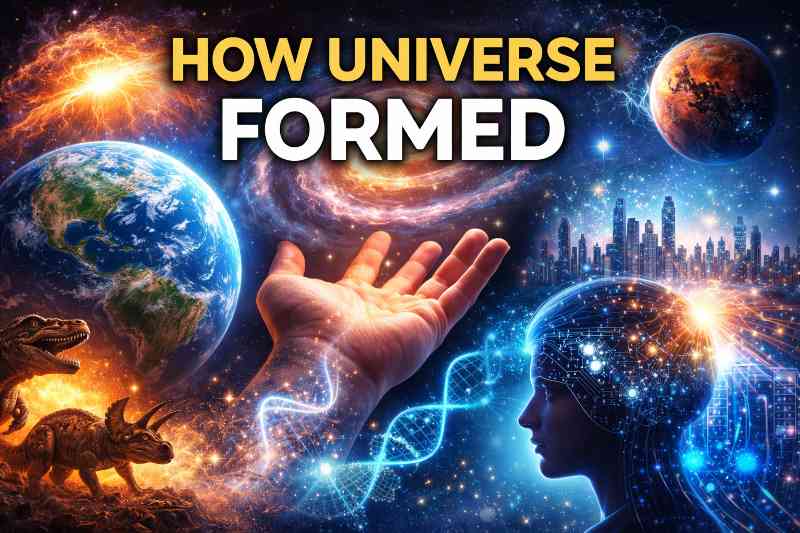
Big History Explained is not just a science topic — it’s a powerful story about everything. From the birth of the universe to humans and modern society, this journey shows how complexity formed even in a universe ruled by entropy.
Introduction to Big History Explained
Imagine watching a scrambled egg slowly becoming whole again. Sounds strange, right? Because deep inside, we all know this is not how the universe works. Things usually go from order to disorder — not the other way around.
This idea comes from the second law of thermodynamics, also called the law of entropy. It tells us that everything naturally moves toward chaos or “mush.”
But then a big question appears: If the universe tends toward chaos, how did complex things like life, humans, and civilizations come into existence?
The Role of Entropy in Big History Explained
Entropy means disorder. Over time, systems break down and become less organized. A neat structure becomes messy. Energy spreads out.
Yet, when we look around, we see incredible complexity — cities, technology, ecosystems, and human intelligence.
This contradiction is the heart of Big History Explained.
Goldilocks Conditions: The Secret Behind Complexity
The answer lies in what scientists call Goldilocks conditions — conditions that are “just right.”
- Not too hot
- Not too cold
- Not too chaotic
- Not too stable
Under these perfect conditions, complexity can grow step by step.
Threshold Moments in Big History Explained
Big History describes key turning points called threshold moments. These are stages where something completely new appears.
1. The Big Bang (13.7 Billion Years Ago)
The universe began from nothing — no space, no time. Suddenly, everything appeared in a massive expansion.
Energy formed matter. Basic particles like quarks and electrons came into existence.
2. Formation of Atoms (380,000 Years Later)
Simple atoms like hydrogen and helium formed. The universe was mostly a simple gas cloud.
3. Birth of Stars
Gravity pulled matter together. When temperatures reached extreme levels, nuclear fusion started — and stars were born.
4. Creation of Elements
Inside stars and during supernova explosions, heavier elements like gold and iron were formed.
5. Formation of Planets
These elements combined to create planets, moons, and solar systems — including Earth.
6. Emergence of Life
On Earth, under perfect conditions (water, energy, chemicals), life began in oceans.
DNA allowed life to store and copy information — a major breakthrough in complexity.
7. Evolution of Complex Life
From single-celled organisms to plants, animals, and eventually humans — life kept evolving.
8. Human Collective Learning
Humans developed language. This allowed knowledge to pass from one generation to another.
This is called collective learning — the key reason humans advanced so rapidly.
Why Humans Are Unique in Big History Explained
Unlike other species, humans don’t just learn individually — we share knowledge.
This means:
- Knowledge grows over time
- Innovation happens faster
- Society becomes more complex
This is why we built civilizations, technology, and a connected global world.
Energy and Human Civilization
Two major energy revolutions shaped human history:
1. Agriculture (10,000 Years Ago)
Humans learned farming, leading to population growth and stable societies.
2. Fossil Fuels (Last 200 Years)
Coal, oil, and gas gave humans massive energy power, accelerating development.
The Fragility of Complexity
As systems become more complex, they also become more fragile.
Modern civilization depends on delicate conditions:
- Stable climate
- Global cooperation
- Energy resources
If these conditions break, complexity can collapse.
Modern Challenges in Big History Explained
Today, humanity faces serious risks:
- Climate change from fossil fuel use
- Nuclear weapons
- Environmental damage
These threats can disrupt the “Goldilocks conditions” that support life and civilization.
The Power of Collective Learning
Despite risks, humans also have a powerful advantage — collective learning.
We can:
- Share knowledge globally
- Solve complex problems
- Create innovative solutions
This makes the future uncertain but full of potential.
Conclusion: Why Big History Explained Matters
Big History gives us a complete picture of our existence — from the Big Bang to modern society.
It teaches us two important things:
- We are part of a long chain of increasing complexity
- Our survival depends on maintaining the right conditions
The future of humanity depends on how well we use our knowledge and manage our power.
FAQ: Big History Explained
What is Big History?
Big History is the study of the universe from the Big Bang to the present, combining science, history, and philosophy.
What is entropy in simple words?
Entropy means disorder or chaos. It explains why things naturally move from order to mess.
What are Goldilocks conditions?
These are conditions that are “just right” for complexity to develop — not too extreme.
Why are humans important in Big History?
Humans are unique because of collective learning — the ability to share and store knowledge across generations.
What is collective learning?
It is the process of sharing knowledge using language, allowing rapid growth in human innovation and complexity.
Focus Keyword Used:
Big History Explained
Related Articles
Reference
External source :- Here
HOMEPAGE :- Here